


Wayne Explains the Market
Real Estate Explained in Plain English
If you’re thinking about selling your home, one of the first questions you’re probably going to ask is, “What should we list it for?”
And sometimes the next question is:
“Why don’t we start a little higher? We can always come down.”
I’ve had that conversation with sellers many times over the years, and I understand the thinking. If your agent states that the house is worth $600,000, why not try $625,000 and see what happens?
The problem is, if buyers don’t think it’s worth $625,000, they may not make you a lower offer.
They’ll likely just move on to the next house.
 This is probably the biggest mistake I see when sellers are trying to figure out how to price their home to sell.
“We Can Always Come Down”
This is probably the biggest pricing mistake I see.
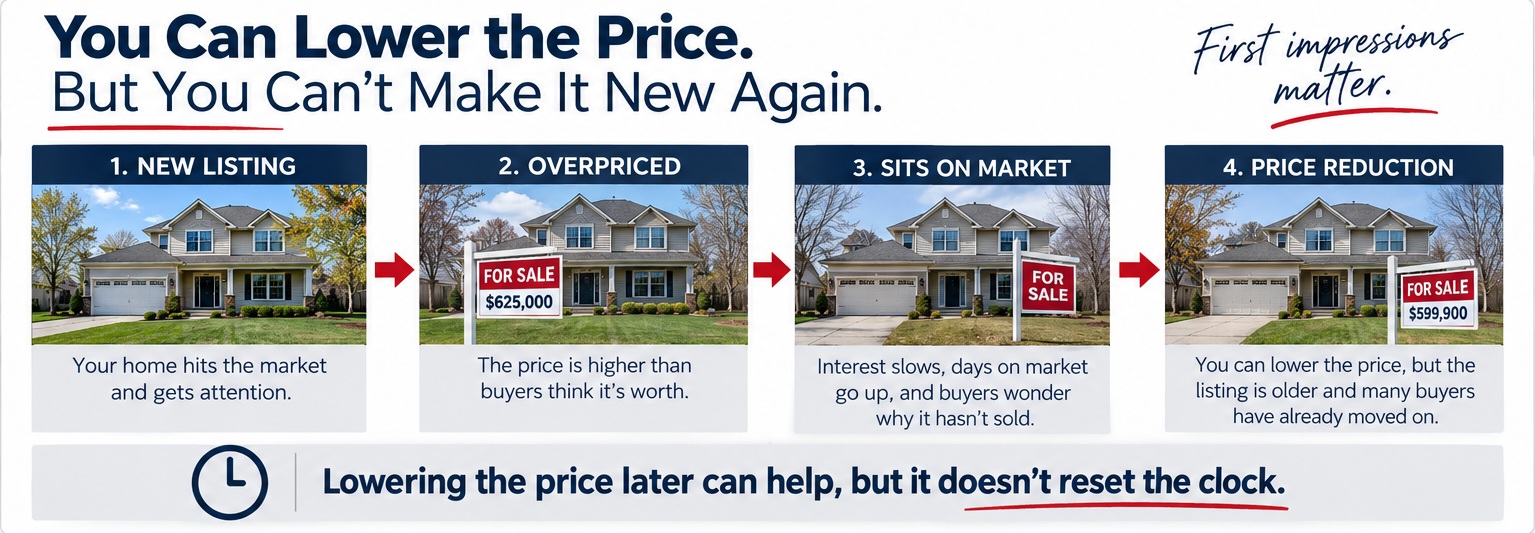
When your house first goes on the market, it’s new. Buyers who have been watching for a home like yours are going to see it. Their agents are going to see it too.
That’s when you have everyone’s attention.
But if the price is too high, buyers may look at the house online and decide it’s not worth seeing. Or they may see it in person, compare it with the other homes they’ve looked at, and decide there’s better value somewhere else.
Sure, you can reduce the price later.
But here’s the real problem. It’s not a new listing anymore.
Buyers have already seen it. They know it’s been sitting on the market. And after a while, some of them start asking the question sellers don’t want them asking:
“Why hasn’t this house sold?”
That’s why I tell sellers that reducing the price later isn’t the same as getting the price right in the first place.
You can change the price. But you can’t make the listing new again.
What You Need Isn’t What Your Home Is Worth
This can be a difficult conversation.
Maybe you’ve figured out how much you need from the sale to buy your next home. Maybe you just spent $40,000 on the kitchen. Maybe there’s simply a number you have in your head that makes selling worthwhile.
All of that matters to you.
But it doesn’t determine what a buyer is willing to pay for your house.
Buyers don’t know what you owe on your mortgage, and frankly, they don’t care how much you spent remodeling the kitchen. They’re looking at your house and comparing it with everything else they can buy for around the same price.
That’s what we have to look at when we’re deciding on an asking price.
“But My Neighbor Got…”
I hear this one too.
“My neighbor sold for $700,000, and my house is nicer than theirs.”
Maybe it is.
But before that sale tells us what your house is worth, we need to look at the details.
How big was their house? How many bedrooms and bathrooms? Was the basement finished? What kind of condition was it in? Did they have a better lot? When did they sell?
Two houses can be right down the street from each other and still not be good comparables.
It’s the same reason I wouldn’t tell you what your home is worth based only on a Zillow estimate. I talked about that in an earlier Wayne Explains the Market, What’s Your Home Really Worth? Why Zillow Isn’t the Whole Story.
A nearby sale is useful.
We just have to make sure that we’re comparing apples to apples.
Your Competition Matters Too
Sold homes tell us a lot, but they’re not the only thing I want to look at.
I also want to know what else a buyer can buy right now.
I’ve said this before: your house isn’t competing against the housing market in general. It’s competing against the other homes a buyer can purchase in the same price range.
Let’s say we’re thinking about listing your house at $625,000.
What does $625,000 buy a buyer in your area?
If there are three other homes around that price that are larger, more updated or offer something yours doesn’t, we need to know that.
And there’s another reason the price matters.
Most buyers searching online set a price range. If their search stops at $600,000 and your house is listed at $625,000, they may never even see it.
 That’s why pricing isn’t just about deciding what number you’d like to get.
 We’re deciding where your house fits in the market.
Then We Watch What Happens
Pricing doesn’t stop the day the listing goes live.
Once buyers start seeing the house, they’re giving us information.
Are people looking at it online but not scheduling showings?
Are we getting plenty of showings but no offers?
Are several buyers saying the same thing?
None of those automatically means we need to reduce the price. But I’m certainly going to pay attention to them.
The market has a way of telling us when something isn’t working.
The mistake is refusing to listen.
Wayne’s Bottom Line
When I’m helping a seller price a home, I’m not trying to find the highest number we can possibly justify.
I’m trying to figure out where the home fits in the market and what buyers are likely to think when they see it.
That means looking at comparable sales, what’s for sale right now, the condition of the home, the location and what buyers are doing in that particular price range.
And no, pricing it correctly doesn’t mean giving your house away.
It means giving yourself the best chance to get buyers interested while the listing is still new.
Because we can always change the price later.
What we can’t do is go back and get those first few weeks again.
If you’re thinking about selling and you’re wondering where your home fits in today’s market, give me a call. I’m always happy to sit down, look at the numbers and help you make sense of your options.
And if you’re not quite ready for that conversation, you can download my free Seller Guide to get a better idea of what to expect when you’re preparing to sell your home.
Until next time, I’m Wayne Zuhl, and I help neighbors find their place in the universe.
Next Week in Wayne Explains the Market
Howell Housing Market Update
Next week, we’re heading back to Howell. We’ll look at what’s happening with home prices, inventory and how quickly homes are selling, and I’ll explain what the numbers mean if you’re thinking about buying or selling in Howell.